
My first lesson in Spanish mobile coverage came in a pueblo blanco in the Axarquía mountains, about an hour inland from Málaga. I was trying to load Google Maps to find a tapas bar someone had sworn by, and my phone simply stared back at me. Nothing moved. No bars. No 4G. Just goats, century-old olive trees and the dawning realisation that I was going to have to ask a human being for directions, in Spanish.
I’m Graham, and as I explained in my earlier guide to mobile services in Spain, I came here as a British expat who knew nothing about how any of this worked. Two years and a lot of driving later, here’s what I’ve learned: mobile coverage in Spain is genuinely excellent — better than what I was used to in the UK — but it has quirks. And the single biggest one has nothing to do with Spain and everything to do with which provider you happen to pick.
Mobile coverage in Spain: the short version
If you’re in a hurry, here’s the whole article in four lines:
- 4G covers virtually the entire country. If there is any signal at all where you are, it will almost certainly be 4G.
- 5G now reaches more than 99% of the Spanish population, according to the government’s 2025 Broadband Coverage Report — but population coverage is not the same as land coverage.
- Coverage is superb on the costas, in the cities and on the islands. It thins out in mountains, deep valleys and the emptier bits of inland Spain.
- Only three companies actually own mobile networks in Spain. Everyone else rents from them.
Who actually owns Spain’s mobile networks?
This is the bit nobody explains when you’re standing in a shop being sold a SIM card.
In Spain there are dozens of mobile phone brands, which operate thanks to three antenna owners. Every other provider — the MVNOs, or operadores móviles virtuales — rents capacity from one of them. Your signal is only ever as good as the network underneath your provider’s logo.
Movistar (Telefónica)
The undisputed king of Spanish coverage. Telefónica was the state monopoly for decades, which means it put masts in the middle of nowhere long before anyone worried about whether those masts would pay for themselves. If there’s a signal to be found in a remote Galician forest or a village of forty people in Castilla, it’s probably Movistar’s.
It has the widest 4G and 5G reach in the country, and independent testing backs that up: Opensignal’s May 2026 report on Spanish network experience put Movistar in its top tier, alongside Vodafone.
The one catch: Movistar keeps 5G+ (its highest tier) for its own customers, so the MVNOs riding on its network get 4G and 5G, but not 5G+.
MasOrange
A very strong runner-up. Since Orange merged with MásMóvil to form MasOrange, its footprint has expanded significantly, and it now hosts the largest stable of virtual operators of the three. Strong 5G in cities and along the coast; slightly less reach than Movistar once you head inland.
Vodafone
Solid in the major urban hubs and the popular expat coastal zones — Marbella, Alicante, Benidorm — and historically the first of the three to push 5G+. Traditionally a little weaker in deep rural inland areas.
The point to take away: if you are buying from a small provider, the question isn't "is this brand any good?" It's "whose masts am I actually using?"
2G to 5G+: the types of mobile coverage explained
Spanish coverage maps are covered in Gs. Here’s what they mean in practice.
- 2G: voice calls and text messages, and not much else. Still switched on in places, mainly as a fallback. If your phone drops to 2G, WhatsApp will crawl.
- 3G: voice and data at the same time, up to around 2 Mbps. Being phased out across Europe, but you’ll still meet it in deep valleys.
- 4G: the workhorse. A stable, broadband-like connection, five to ten times faster than 3G. This is what you’ll be on the vast majority of the time, and for the vast majority of what you do, it’s plenty.
- 5G: up to ten or twenty times faster than 4G, with much lower latency. Standard across Spanish cities and increasingly common in towns and along the coast.
- 5G+ (5G Standalone): 5G running on a fully 5G core rather than piggybacking on 4G infrastructure. Faster still, lower latency again. Concentrated in the larger cities, and generally reserved by the big three for their own customers.
Which operators offer 5G in Spain — and do you actually need it?
Practically all of them. All three network owners run 5G, and the great majority of MVNOs pass it on, Lobster included.
Where you’ll find it: if you’re in Madrid, Barcelona, Málaga, Valencia, Seville or anywhere along the built-up costas, 5G is simply everywhere. I get faster downloads at a beach bar in El Palo than I ever did in central Manchester. Head inland into the campo, though, and you’ll drop to 4G — or 3G at the bottom of a valley.
And here’s the unglamorous truth about that. The CNMC’s April 2026 report on rural service quality found that 96% of urban municipalities have at least one 5G network available, against 82.2% of rural ones — and only 15.4% of rural municipalities have three competing 5G operators to choose from, compared with roughly half of urban ones. So in the countryside, 5G is not just rarer; you have far less choice about who provides it.
My honest advice on 5G: don’t let it drive your decision. For Maps, WhatsApp, Instagram, online banking and streaming the football, a rock-solid 4G signal is more than enough. I’d take reliable 4G that works in every room of my flat over patchy 5G that vanishes when I walk into the kitchen. Speed is what the marketing sells you. Reliability is what you actually live with.
How coverage varies across Spain: coast, islands and inland
Spain is not one coverage story, it’s three.
The cities and costas (Costa del Sol, Costa Blanca, Costa Cálida). Near-perfect. These areas have developed around large urban centres and tourism, and, increasingly, remote work. Dense mast networks, strong 5G, very few surprises. I’ve streamed a Premier League match in HD from a beach in Nerja. Try that in Cornwall.
The islands (Canaries and Balearics). Better than most people expect, including in the mountainous parts of Tenerife and the interior of Mallorca. The main towns and resorts are well served; the volcanic interiors and the smaller islands are patchier.
Inland and la España vaciada. This is where it gets real. If you’re buying a finca or a cortijo in the hills, coverage becomes a genuine buying criterion, and a Telefónica-based network is the safe bet. Thick stone walls don’t help either — plenty of village houses have a perfectly good signal in the street and none at all in the kitchen.
Lobster mobile coverage maps for 2026
Because Lobster runs on the Telefónica network, these maps show what you actually get: 4G and 5G across the mainland, the Balearics and the Canaries.
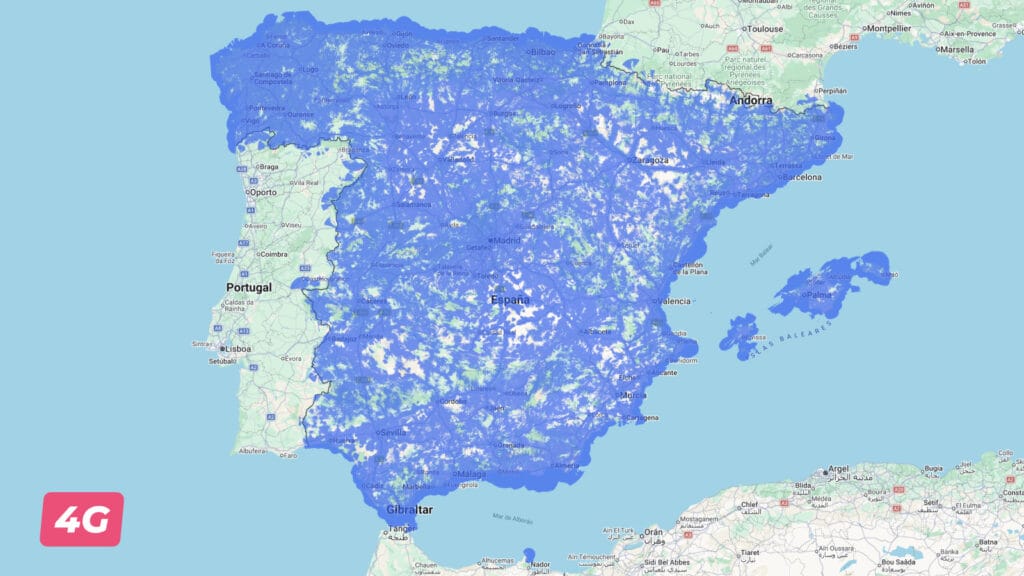
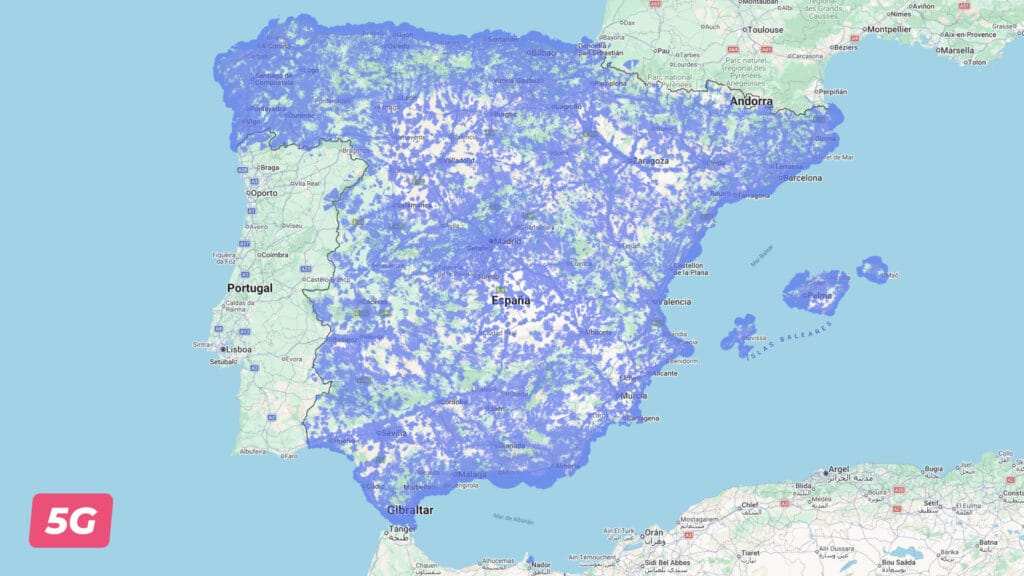
Look at the two mainland maps side by side and the pattern is obvious. 4G is a solid wash of colour from Galicia to Almería. 5G is concentrated along the coasts, the major road corridors and the cities, and thins out over the Meseta, the Pyrenees and the sierras. That’s not a Lobster limitation — it’s the shape of 5G in Spain full stop, and it looks much the same on every operator’s map.
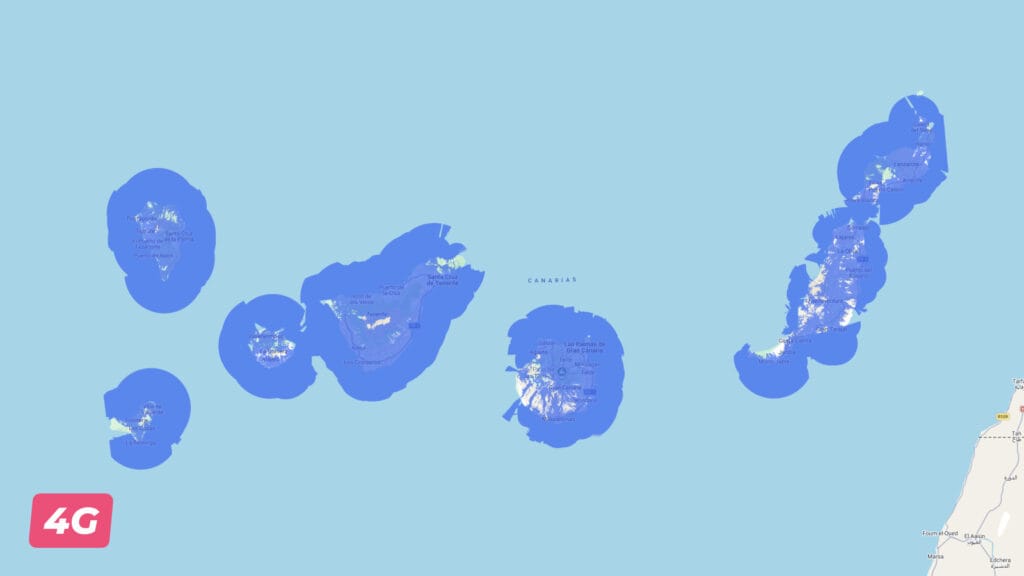
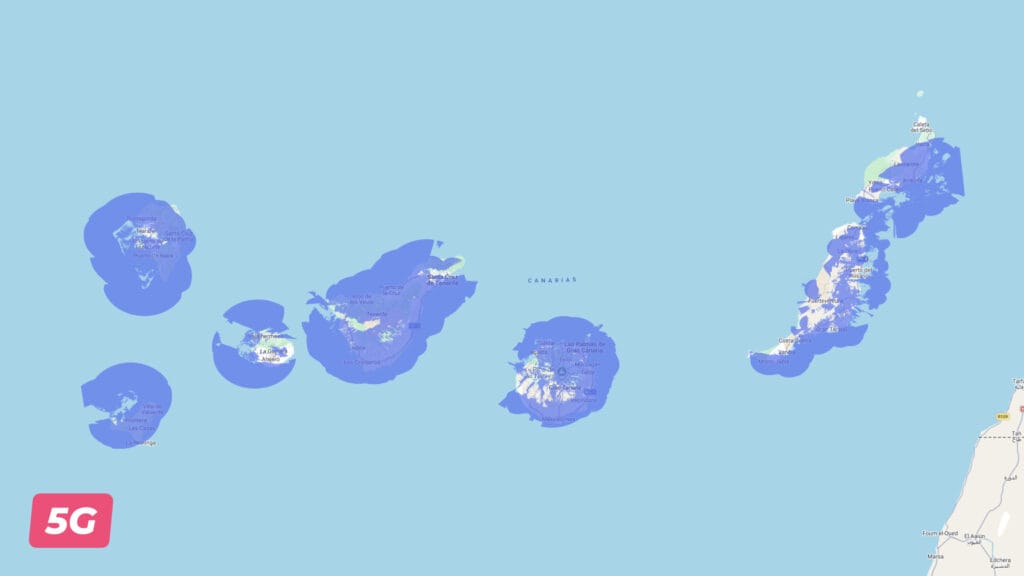
In the Canaries, coverage tracks population and terrain almost exactly. The coastal rings of Tenerife and Gran Canaria, the southern resort belts and the main towns of Lanzarote and Fuerteventura are well covered. The high ground — Teide, the ridges of La Gomera and La Palma — is where you’ll find the gaps.
One thing a map can’t tell you: whether the signal reaches your sofa. Maps model outdoor coverage. Walls, hills and how far you sit from the nearest mast all change the answer. Treat them as a good first filter, not a guarantee — and use the address-level checks in the next section before you commit.
How Lobster uses the Telefónica network
Lobster is an MVNO running on Telefónica (Movistar) infrastructure. In plain English: same masts as Spain’s best-covered network, without the Movistar price tag, and with everything in English: the website, the bills, the SMS alerts, the person who answers the phone.
Every Lobster plan includes 4G and 5G where it’s available. You won’t get 5G+, because Movistar keeps that for its own customers, but as I said above, that’s a distinction you’ll notice on a speed test and almost nowhere else.
For me it’s been plain sailing since I switched. I rarely even glance at which “G” I’m on, because the data just keeps flowing.
The expat trap: not checking which network your provider uses
This is the mistake I made, and it’s the reason I’m writing this article.
I bought a cheap SIM from a provider I’d never heard of, on the strength of the price and nothing else. It turned out to rent capacity from a network with a blind spot sitting more or less directly over my flat. Great signal at the supermarket. Nothing at my desk. Two months of standing on the balcony to take calls before I worked out what was going on.
The provider wasn’t lying to me. It just wasn’t the network I needed. Nobody had told me those were two different things — which is exactly the sort of gap that catches you out when you’re new here and reading everything in your second language. If that sounds familiar, my piece on English-friendly mobile providers in Spain covers the rest of that particular minefield.
How to check mobile coverage before you commit
Don’t take my word for any of this. Check it. Here’s the order I’d do it in.
- Check the network owner’s official map. Every operator publishes an address-level coverage checker on its Spanish site — search for “cobertura Movistar”, “cobertura Orange” or “cobertura Vodafone”. Since Lobster runs on Movistar’s network, the Movistar map is effectively your map. Put in the actual street address, not just the town.
- Cross-check with the CNMC. Spain’s telecoms regulator runs a free national coverage map combining official measurements with real user speed tests, which is a useful reality check on the operators’ own optimism. Search for “mapa de cobertura CNMC”.
- Look at independent crowdsourced maps. nPerf and Opensignal both publish coverage and speed maps for Spain built from real devices rather than modelling. They’re less tidy than the official maps and rather more honest.
- Ask the neighbours. If you’re viewing a property, ask the owner or the neighbours: “¿Qué cobertura tienes aquí?” If the answer is “only Movistar works up here”, you’ve just been handed the most valuable coverage data you’ll get all week.
- Do the bar test. Walk to the nearest village bar. If the locals are scrolling TikTok without visible frustration, you’re fine. It has never once let me down.
How to change the network type on your phone
Sometimes the fix isn’t the network, it’s your handset stubbornly hunting for a 5G signal that isn’t there and draining your battery in the process. Forcing it down to 4G can genuinely help in patchy areas.
On Android:
Settings → Connections or Network & internet → Mobile networks → Preferred network type → choose 5G/4G/LTE/3G.
On iPhone:
Settings → Mobile (or Mobile Data) → Mobile Data Options (or select your line) → Voice & Data → choose your preferred option.
If you’re somewhere with a weak, flickering 5G signal, set it to 4G/LTE and see whether things settle down. You can always switch back.
What about roaming? The “back home” factor
Coverage isn’t only about where you live — it’s about where you travel, and for Brits that means one specific question.
Since Brexit, plenty of Spanish providers have reintroduced charges for roaming in the UK, because it’s no longer in the EU. It’s an easy thing to miss when you’re comparing plans on price alone, and an expensive thing to discover at Gatwick.
Lobster includes roaming in the UK and the EU in all its mobile plans, at no extra cost. I went back to Leeds for a wedding recently and my phone behaved exactly as it does in Málaga: same data, same calls, nothing added to the bill. The full detail is in the roaming help page, and if you’re calling rather than travelling, the international calls page lists what’s included.
My verdict on mobile coverage in Spain
Can your phone keep up in Spain? Comfortably. In two years here I’ve had fewer dropped calls than I used to have in a single month in the UK. The infrastructure is modern, well funded and surprisingly far-reaching — Spain is one of the best-connected countries in Europe, and it isn’t close.
The two things worth remembering:
Coverage is about the network, not the brand. Work out whose masts your provider is renting before you look at anything else. If you’re anywhere rural, or you spend your weekends in the sierras, choose something built on Telefónica.
Don’t buy 5G you’ll never notice. Reliable 4G everywhere beats spectacular 5G in three postcodes.
The simplest way to get the first without paying over the odds is Lobster, which runs on Spain’s best-covered network, no contract, and a customer service team that answers in English on the first attempt.
Want to see what that costs? Have a look at Lobster’s pay-as-you-go plans.
Mobile coverage in Spain: frequently asked questions
Which network has the best coverage in Spain?
Movistar (Telefónica), by some distance in rural areas, thanks to decades of mast-building as the former state operator. Vodafone and MasOrange are strong in cities and along the coast. Independent testing in 2026 placed Movistar and Vodafone in the top tier for overall network experience.
Does Spain have 5G?
Yes. 5G reaches over 99% of the Spanish population, and all major operators offer it. Availability is much thinner in rural municipalities than urban ones.
Which network does Lobster use?
Lobster runs on the Telefónica (Movistar) network — the most extensive mobile network in Spain. All Lobster plans include 4G and 5G where available.
Will my UK phone work in Spain?
Almost certainly. Any handset sold in the UK or EU in the last decade supports the Spanish 4G and 5G bands. Just check it isn’t network-locked before you put a Spanish SIM in it.
Is there mobile coverage in rural Spain?
Generally yes for 4G, which is close to universal. 5G is a different story: only around 82% of rural municipalities have any 5G at all, and choice of operator is far more limited. In the hills, a Telefónica-based network is the safest bet.